
Supporting Your Child’s Feeding Journey
Understanding feeding difficulties, reducing mealtime stress, and celebrating every small step toward a positive relationship with food.
If you’ve ever had to feed a small human, you probably know sometimes it feels like an insurmountable task. From sudden changes in preferences and drastic changes in appetite, as well as refusals to consume anything that looks remotely healthy. Many children are picky or selective eaters, whether they have ASD or not.
In addition to typical toddler food preferences, when folks have ASD, they are statistically more likely to be picky eaters, have sensory sensitivities that contribute to food selectivity, or show signs of AFRID (Avoidant/Restrictive Food Intake Disorder). And this is not limited to children; anyone at any age can be dealing with these difficulties around food. No matter the age, there are strategies to help.
A very important note.
If your family member is experiencing feeding difficulties, it is important to remember that eating challenges can have many contributing factors. Before beginning any intervention, families should work closely with their loved one's doctor to rule out medical concerns such as gastrointestinal issues, allergies, reflux, or other conditions that may impact eating, including dental concerns. A registered dietitian or nutritionist can help assess nutritional intake and identify any nutrient deficiencies, while speech-language pathologists (SLPs), occupational therapists (OTs), and feeding specialists can evaluate oral-motor skills, chewing and swallowing abilities, sensory sensitivities, and other factors that may affect someone’s ability or willingness to eat certain foods. Because feeding is a complex skill that involves medical, nutritional, sensory, motor, communication, and behavioral components, a collaborative team approach can help ensure that your family member receives comprehensive support tailored to their individual needs. Behavior analysts can help identify environmental and behavioral factors that may contribute to feeding challenges and collaborate with the treatment team to develop supportive, individualized strategies.
The main takeaway here is that support is available. If food and eating have become a source of stress, anxiety, and a negative experience overall, you do not have to figure it out all alone. There are many professionals with a wealth of experience and knowledge to help your family find what works for you.
What May Be Behind Food Refusal?
Before attempting any strategies to address eating difficulties, it’s important to understand WHY someone might be refusing to eat or trying different foods. In addition to medical or physiological reasons, there can be many complex factors beyond simply not liking certain things.
Sensory sensitivities (texture, taste, temperature, smell)
Sensory sensitivities can go beyond ‘I just don’t like this’; unpleasant sensory input can be extremely distressing, even painful to some.
You might see signs of actual disgust, such as grimacing, gagging, or even vomiting. These reactions don’t automatically mean the cause of the refusal is sensory sensitivities, but it’s extremely important to pay attention to them.
If your family member isn’t able to communicate their experiences to you and you’re having trouble identifying what sensory aspects are preferred or not preferred, consider using a mealtime journal.
Anxiety around new foods
Change can be difficult. New foods, smells, and textures can be unpredictable and cause anxiety.
Additionally, if there have been previous negative experiences when trying new foods, it can bring up this anxiety as well.
Desire for predictability and routines
Sometimes, certain foods can become ‘safe foods’ because they feel and taste the same every single time you eat them. Your favorite brand of chips generally tastes exactly the same every time you open a new bag.
But things like fruits and vegetables, or restaurant-prepared food, can vary each time. One strawberry can be perfect and sweet, while the next one is a little mushy and sour.
Previous negative experiences with eating
If the last time a new food was introduced was a negative experience, it can make each new presentation of new food a challenge.
If the last time a green vegetable was presented, it was mushy, all other green vegetables might be refused.
Or if there have been issues with choking or gagging, these negative experiences can make trying new things difficult.
It can be difficult to determine exactly what factors are contributing to refusal. A mealtime journal can be a great tool for collecting data to share with your medical team or therapy providers, helping assess where additional support may be needed.
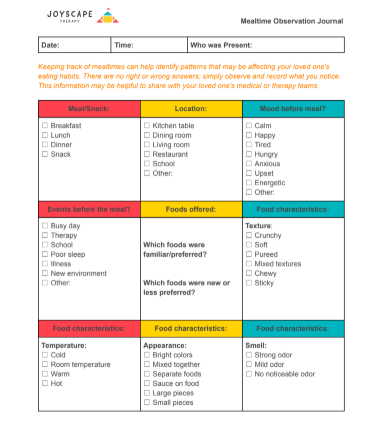
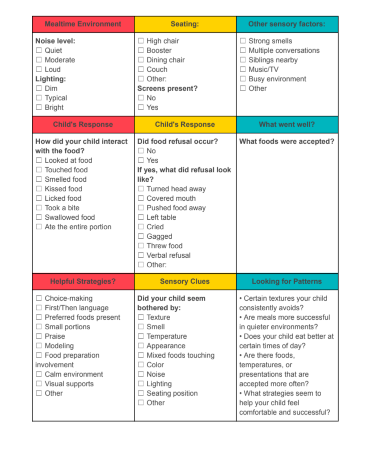
(Joyscape clients can access this mealtime journal on our family resource site here. )
Start with Safety and Comfort
In addition to collaborating with medical and other providers for assessment, there are some general strategies anyone can implement to help improve mealtimes. Just as a good therapeutic relationship starts with building trust and rapport and fostering a positive environment, the initial steps to improving mealtime routines focus on safety and comfort.
Providing stable seating with good posture support
For some, things like poor core strength or other motor difficulties can add another layer of discomfort to regulate and cope with when presented with new foods.
A highchair or specialized feeding chair may be beneficial during mealtimes to minimize postural difficulties.
It’s very important to ensure any seating arrangement used specifically for mealtimes is paired with positive experiences. When introducing a new chair or routine, make sure it’s enjoyable by playing with favorite toys, watching favorite videos, and generally having fun in the seat before using it at mealtimes.
Establishing predictable mealtime routines
Having predictable routines can help alleviate the anxiety of the unexpected. When we know what is expected of us, we can often mentally prepare and understand when it will be over.
Try to eat meals at the same place and time, especially when introducing new or less-preferred items.
Visuals can be helpful reminders for things like washing hands, putting on a bib, sitting, and cleaning up when done.
Reducing unnecessary distractions or sensory overwhelm
Life is hectic, and it can be really difficult for anyone with sensory sensitivities to tolerate and regulate during a potentially stressful situation, like trying a new food, when they’re already overwhelmed by rushing between activities, tired from school, and siblings are loudly chasing each other in the same room.
Reduce distractions like unnecessary toys, sounds, lights, or the itchy sweater they wore outside.
Creating a calm, low-pressure atmosphere
Helping someone regulate through a stressful situation often starts with modeling co-regulation. Remember that it's okay if a meal doesn't end with trying a new food. Some days, success may simply look like sitting together at the table, communicating "all done" appropriately, or remaining calm while a new food is nearby. Progress isn't linear, and honoring your loved one's communication while continuing to create positive opportunities helps build trust over time.
Our intention is to make mealtimes feel safe and comfortable, so that when difficult foods are presented, there is enough trust and a calm environment to work through those difficult feelings.
It's also important to pay attention to your loved one's natural hunger and fullness cues. Offering meals and snacks on a predictable schedule while avoiding pressure to "clean the plate" can help children learn to trust their bodies and create more positive experiences around food.
Things to Avoid During Mealtimes
When mealtimes become stressful, it's natural to want to do whatever it takes to get your loved one to eat. However, some well-intentioned strategies can unintentionally increase anxiety around food and make future mealtimes even more difficult. Whenever possible, try to avoid:
Pressuring or forcing someone to take "just one more bite."
Using punishment or criticism when foods are refused.
Comparing eating habits to siblings or peers.
Expecting immediate success with new foods.
Turning every meal into a therapy session.
Ignoring signs of pain, gagging, choking, or significant distress.
Instead, focus on creating predictable, low-pressure opportunities to explore food while celebrating even the smallest signs of progress. Building trust and comfort around food often leads to more meaningful, long-term success than focusing only on the number of bites eaten. Not every meal has to be a teaching opportunity. Sometimes the goal is simply to enjoy time together and maintain a positive relationship with food.
Making Food Exploration Fun
For many people, positive interactions with food outside of mealtimes can reduce pressure and increase willingness to explore new foods. Getting creative or simply including your family member in meal preparation can be wonderful ways to build comfort and familiarity. During these activities, there should be no expectation or pressure to eat or taste any food. Instead, focus on creating enjoyable, low-pressure opportunities to explore. If tasting happens naturally, that's a great bonus, but it isn't the goal. Any playful interaction with food counts.
Get Creative with Food
Paint with colorful fruits, vegetables, yogurt, sauces, or pudding (channel your inner Bob Ross!).
Build silly faces or fun designs with fruits and vegetables.
Explore different textures using sensory bins with dry or cooked foods (when appropriate for your child).
Use cookie cutters with foods like sandwiches, cheese, fruit, bread, or even cooked vegetables to make interesting shapes.
Encourage Pretend Play
Host a tea party using real snack items.
Pretend to feed stuffed animals, dolls, or action figures.
Play "restaurant," where your loved one takes food orders, serves meals, or acts as the chef.
Involve Them in Everyday Mealtime Tasks
Wash fruits and vegetables.
Help stir, pour, or measure ingredients.
Pick recipes together.
Set the table.
Help serve food to family members.
Assist with simple meal preparation whenever it's safe and appropriate.
Explore Food Through Everyday Experiences
Sort foods by color, shape, or size using bowls or muffin tins.
Go on a grocery store scavenger hunt to find foods of different colors or textures.
Smell herbs and spices together and talk about what you notice.
Grow herbs, vegetables, or other easy plants at home.
Play "taste detective" by describing how foods look, smell, or feel, without any expectation of eating them.
Remember, the goal isn't to convince someone to eat. The goal is to help food become more familiar, predictable, and enjoyable over time. Positive experiences today can build the foundation for greater confidence tomorrow
How Behavior Analysts Support Feeding
After ensuring that proper collaboration has taken place to rule out medical, dental, or other physiological concerns, and that sensory and regulation factors are addressed, one way to systematically intervene is to use shaping or desensitization. Shaping is an approach that simply means reinforcing each small step toward the overall goal. For example, your family member may first be comfortable looking at a new food, then touching it, smelling it, bringing it to their lips, licking it, taking a tiny bite, and eventually eating it. Every successful step is acknowledged and celebrated, helping build positive experiences with food over time.
With shaping, we start at a level where your loved one is already successful. Once they consistently feel comfortable with that step, we gradually introduce the next small challenge. This allows confidence to grow while keeping mealtimes positive and supportive. It's okay if your loved one communicates that they're finished or need a break. Teaching safe, appropriate ways to communicate during meals is just as important as increasing food acceptance.
Think of it like learning any new skill; most people don't ride a bike or tie their shoes perfectly on the first try. Eating new foods is no different. By recognizing and encouraging progress, no matter how small, we can help reduce anxiety, increase confidence, and make mealtimes feel more positive for everyone involved.
Every person's journey with new foods looks different, so there isn't one "correct" sequence for learning. Behavior analysts individualize each step based on where someone is already successful and comfortable.
For one person, the first goal may simply be tolerating a new food on the table. Another may begin by helping prepare the food, smelling it, or touching it with a utensil before progressing to direct contact. Others may be ready to bring the food closer to their face, touch it to their lips, take a tiny taste, or eventually eat larger amounts.
The important part isn't the exact order; it's making each step achievable, celebrating success, and gradually building confidence over time. By meeting someone where they are instead of expecting immediate acceptance, we create opportunities for lasting, positive change.
Follow Your Loved One's Pace
It can be tempting to focus on getting to the "finish line", trying the new food, eating a full serving, or adding another item to the menu. But meaningful progress often happens long before that.
When someone feels heard, respected, and successful, they're more likely to continue participating in future opportunities. If they communicate that they need a break or have had enough for the day, that communication is valuable too. Learning to advocate for themselves during mealtimes is an important skill.
Rather than asking, "Did they eat it?" try asking:
Did they stay regulated longer today?
Did they tolerate the food being nearby?
Did they communicate their needs appropriately?
Did they participate willingly?
Did they end the experience feeling safe?
Those are meaningful accomplishments that help build a healthier relationship with food over time.
Celebrate Progress, Not Perfection
This is a gentle reminder that, just like any new skill, it takes time and practice. And if there is already a negative learning history around meal times, it takes even more time to establish new, positive routines. As supporting family members, you are doing your best. And those we are helping to support are doing their best to work through difficult experiences. Bad days and sometimes even regression happen. But if we can focus on making meal times and shaping sessions as positive and enjoyable as possible for everyone involved, that is a win to celebrate.
Some sessions may not end with eating a whole portion of a new food. They may not even end with looking at them some days! But there are always skills we can focus on as reminders of success. Positive reinforcement is a powerful tool. This can look like praise, high fives, making silly faces, playing favorite songs or videos, or getting pieces of our favorite snack to help wash down a much less preferred vegetable.
Rather than focusing only on eating, we can also celebrate smaller successes, such as:
Sitting at the table
Tolerating a new food on the plate
Touching or smelling a food
Using appropriate communication to express preferences
Acknowledging these steps can help build confidence and motivation, as well as keep shaping sessions feeling positive.
Ultimately, feeding is a complex skill that takes time, patience, and practice. You don't have to navigate these challenges alone; whether you are working with your medical team, dietitians, OTs, SLPs, or behavior analysts, your collaborative care team is there to help. By creating a foundation of safety, fostering trust, and celebrating every small win, you are giving your loved one the best possible opportunity to explore new foods and build a positive relationship with mealtime.
Remember, progress isn't measured by how many bites are eaten in one meal; it's measured by growing comfort, confidence, and positive experiences with food over time. Every small step is worth celebrating, and those small steps often lead to meaningful, lasting change.
References & Further Reading
Harrison, K., & Covington, G. From Refusal to Readiness: Applying ABA to Transform Feeding Therapy. Bloom Behavioral Solutions/Bloom Feeding Institute.
Koh, K. L., et al. (2020). Feeding Difficulties and Food Selectivity in Children with Autism Spectrum Disorder.
Caldwell, P. H., et al. (2021). Food Selectivity and Feeding Disorders in Children with Autism Spectrum Disorder: A Review of the Literature and Clinical Implications.
Norris, M., et al. (2021). Prevalence and Factors Associated with Selective Eating in Children with Autism Spectrum Disorder.
Author's Note: This article was informed by current research, continuing education, and clinical experience. It was developed as an educational resource for caregivers and is not intended to replace individualized medical or therapeutic advice.